Top Stories of the Week

More evidence of water on Planet Mars

New images of a craggy, fissure-filled canyon on Mars provide evidence of long-term underground water flows that may have provided a suitable environment for microbial life, scientists said.
''If there are any sort of fossils, these would be good places to look,'' the University of Arizona's Chris Okubo said in a telephone interview yesterday.
While previous NASA probes have found evidence of past and even present-day water on Mars, scientists previously had few clues if the water existed long enough for life to evolve.
The new findings show light-colored features cutting across dark bands in an area known as Candor Chasma. Okubo and his colleagues believe they are looking at places where rock has been chemically altered by water flowing across the fractures.
''Fluids apparently resided within rock long enough to allow geochemical processes to occur,'' Okubo said. ''That's typically very slow.'' In addition, the rock was once underground, providing a safe haven for any microbes from radiation and atmospheric hazards.
''These areas are very good for being an oasis for any sort of biologic activity,'' Okubo said.
Similar terrain exists on Earth, such as in the Colorado plateau.
''It was sort of surprising to see these images from Mars because it's almost exactly like what we see in the field,'' Okubo said.
Scientists say the fractures, which are several hundred yards (meters) long and about four yards (meters) wide, likely existed before any pools of water seeped underground.
''The fractures then acted as nice conduits for the fluids to flow underground, like pipes,'' Okubo said. ''What we're seeing now is an exposure of bedrock that was buried at several kilometers (miles) depth at the time the fluids were present.'' Images of Candor Chasma, one of several large canyons that are part of Mars' sprawling Valles Marineris, were taken during tests last fall of NASA's new Mars Reconnaissance Orbiter. The pictures show fractures stretching hundreds of yards (meters) across bedrock.
Similar features have been found by the Mars rover Opportunity, which currently is perched at the rim of a large crater known as Victoria Crater. Scientists are considering dispatching the rover into the crater for a closer look. The rover already has found evidence of a one-time salty shallow ocean at its landing site.
The discovery was described Friday's issue of the journal Science and at the American Association for the Advancement of Science's annual meeting in San Francisco.
Labels: enviornment
Huge mudflow inevitable from volcano lake
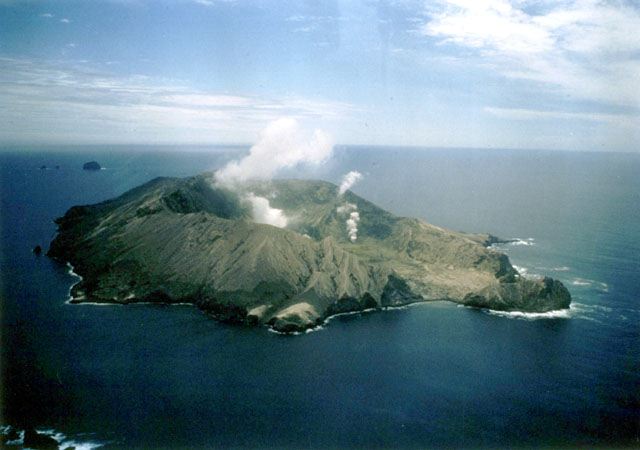
A crater lake on a New Zealand volcano used as a backdrop in the ''Lord of the Rings'' films is on the verge of collapsing and could send a torrent of muddy water down the mountain in coming weeks, media reported today.
Melting snow on Mount Ruapehu has filled the lake to within 1.5 metres of its lip, according to the New Zealand Herald newspaper.
The 2,797-metre volcano is the highest mountain in the North Island and home to two commercial ski fields.
Scientists say a lahar, or mudflow composed of volcanic material and water, is inevitable as warm summer weather causes the snow to melt and fill the lake.
''It is still expected the earliest the dam might start collapsing to create a lahar down the Whangaehu River is February/March,'' the Herald quoted a Department of Conservation official as saying.
On December 24, 1953, a lahar rushing down the Whangaehu River destroyed a railway bridge, causing a packed passenger train to plunge into the river, killing 151 people on board.
Since then, a barrier of boulders and gravel has been built to divert any lahar flowing into the river. No major towns would be in its path.
Mount Ruapehu, which last erupted in 1995 and 1996, creating the present crater dam, is in Tongariro National Park, where Peter Jackson filmed some scenes for his ''Lord of the Rings''.
Labels: enviornment, others
Oceans may rise upto 140 cms by 2100 for warming

The world's oceans may rise up to 140 cms by 2100 due to global warming, a faster than expected increase that could threaten low-lying coasts from Florida to Bangladesh, a researcher said.
''The possibility of a faster sea level rise needs to be considered when planning adaptation measures such as coastal defences,'' Stefan Rahmstorf of the Potsdam Institute for Climate Impact Research wrote in the journal Science.
His study, based on air temperatures and past sea level changes rather than computer models, suggested seas could rise by 50-140 cms by 2100, well above the 9-88 cms projected by the scientific panel that advises the United Nations. A rise of one metre might swamp low-lying Pacific islands such as Tuvalu, flood large areas of Bangladesh or Florida and threaten cities from New York to Buenos Aires.
''The computer models underestimate the sea level rise that has already occurred,'' Rahmstorf told Reuters of a rise of about 20 cms since 1900. ''There are aspects of the physics we don't understand very well.'' Sea level changes hinge on poorly understood factors such as the pace of the melt of glaciers and of ice sheets in Greenland and Antarctica. Water also expands as it gets warmer but the rate of penetration of heat to the depths is uncertain.
''My main conclusion is not that my forecast is better but that the uncertainty is much larger because of the different results you get with reasonable methods,'' he said.
Almost all climate scientists reckon the world is warming because of emissions of greenhouse gases from human use of fossil fuels in factories, power plants and cars. Rising temperatures could bring more droughts, floods and heatwaves. Tides Rahmstorf likened his approach to predicting the height of tides along a coast, largely based on past observations.
He said seas were 120 metres below present levels during the last Ice Age 20,000 years ago and 25-35 metres higher than the present in the Pliocene epoch 3 million years ago. In the Ice Age temperatures were 4-7 Celsius cooler than today and 2-3 C warmer in the Pliocene. That suggested sea levels change 10-30 metres per rise or fall per degree Celsius over thousands of years.
The UN climate panel has projected temperatures will rise by 1.4-5.8C by 2100, mainly because of human influences. ''Sea level is a very slow component of the climate system so what we see by the year 2100 is just a small percentage of the total we are causing,'' Rahmstorf said.
There was still time for the world to cut greenhouse gas emissions but he said the slow pace of U.N. talks on extending the UN's Kyoto Protocol beyond 2012 ''gives you the impression that governments are not very well aware of how urgent the whole problem has become''. Coastal cities in the North Atlantic -- from New York to London -- could be especially vulnerable because a possible slowdown of ocean currents could also raise sea levels in the North Atlantic and lower them in the southern hemisphere.
''Any time you change ocean currents you change the sea surface...if you slow down the North Atlantic current you get a rise in the North Atlantic,'' Rahmstorf said.
Labels: enviornment, others
Life loss in US Winter storm
Temperatures stayed below freezing as hundreds of thousands waited for their electricity to be restored after a devastating winter storm that has been blamed for at least 19 deaths across the US.
In the latest incidents, icy weather contributed to the deaths of four St. Louis residents. Two men died of suspected carbon monoxide poisoning after they tried to keep warm by burning coal on their stove.
One man was found dead in his yard from possible hypothermia and an elderly man was found dead at the bottom of his home's stairs. "This is not over. As long as the power is still out, there are still people at risk," said St. Louis Mayor Francis Slay.
Temperatures barely rose to minus-6 Celsius on Sunday. City officials encouraged people to stay at temporary shelters, rather than try to tough it out in residences without power.
The storm was blamed for at least 15 other deaths as it spread ice and deep snow from Texas to Michigan and then blew through the Northeast.
Thousands of travelers were stranded by canceled flights, highways clogged by abandoned vehicles and stalled trains.
source
NDTVLabels: enviornment, international, others
Quake hits Sumatra island and Typhoon in Philippines
Philippines : Typhoon Durian killed 146 people in the central Philippines after high winds and rain triggered deadly mudslides, the head of the Philippine Red Cross said today.
Mud and rocks covered two villages close to Mount Mayon, around 322 km south of Manila. At least five other villages were also hit, officials said.
Sumatra island : A moderate intensity earthquake of magnitude 6.4 on Richter scale today hit the northern part of Indonesia's Sumatra island at 0928 hrs IST, an India Meteorological Department report said.
The quake hit at 0928 hrs IST and was epicentred at a latitude of 03.7 degree north and a longitude of 99.5 degree east, according to the IMD report.
Labels: breaking news, enviornment, international
South Korea suspected second bird flu case
South Korea farm ministry said today it had found a second suspected case of highly pathogenic bird flu at a poultry farm, after confirming on Saturday it had its first outbreak in three years of the H5N1 strain.
The ministry said the second suspected case was at a poultry farm near where the first case had been found and they are checking to see if the virus has spread through the country.
South Korea has nearly completed culling all 236,000 poultry within a 500 metre (1,640-ft) radius of a farm in North Cholla province about 170 km (100 miles) south from Seoul where officials said the H5N1 avian influenza strain had been detected.
Labels: enviornment, international, others








 System insensitive, says rape victim
 Open Letter to Shayan Munshi from IBNlive
 I have not said anything wrong
  2007 will be world's warmest year
 Satyajit Ray - A Visualizer and His Films
 "I desire to kill again"